


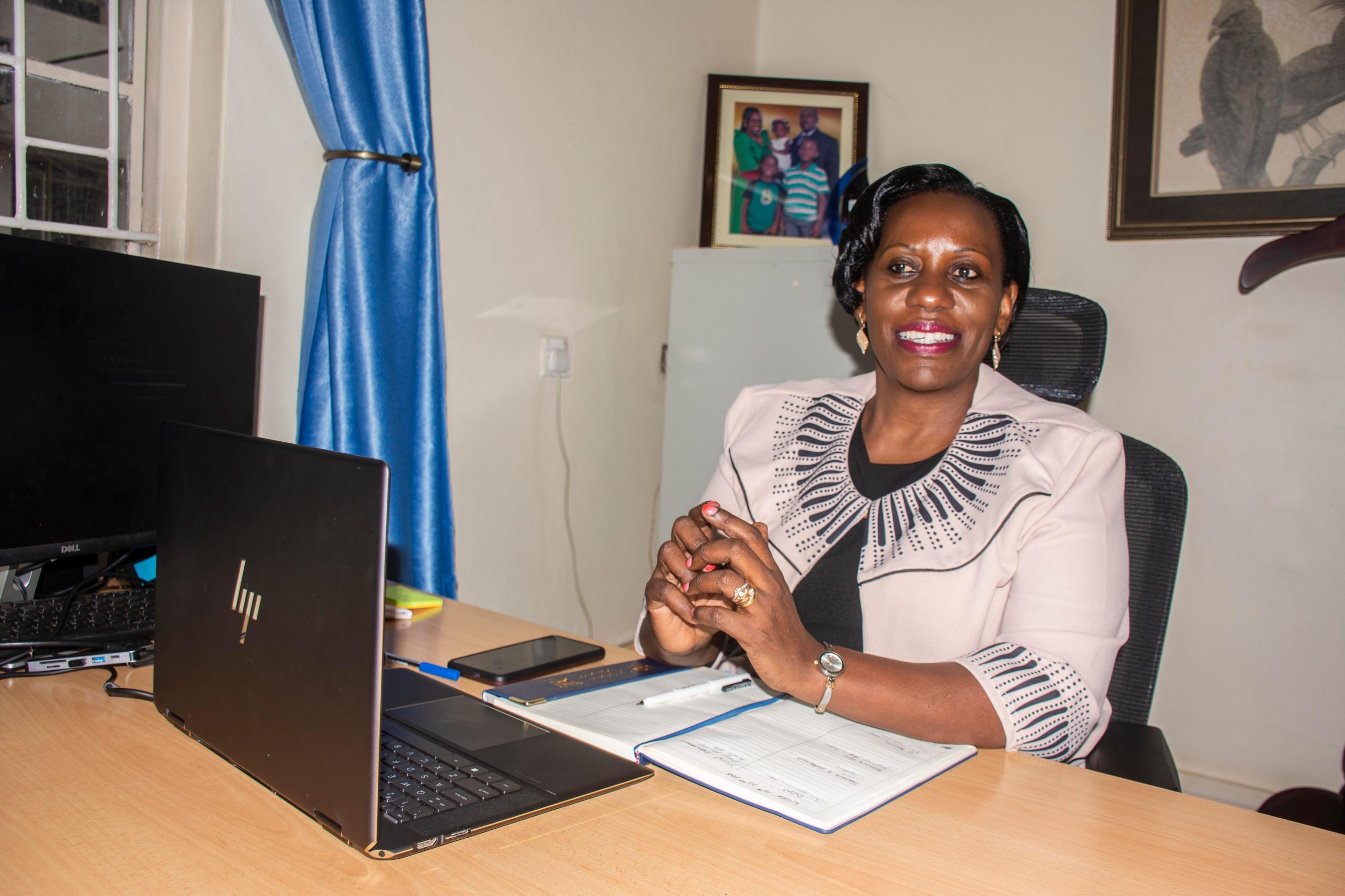
Ms. Namaalwa describes mentorship as a guiding force that has significantly contributed to
her achievements and professional journey, Joan Salmon writes.
The leadership journey is not without hurdles, yet amid the challenges, one must not overlook the profound joys that progress brings. Prof Justine Namaalwa Jjumba is proud of the path she has taken
and what she has been able to achieve despite any challenges she might have faced.
The professor states that mentorship has been one of the things that has brought her to where she is, and it started during her second year as a student of Bachelor of Science in Forestry at Makerere University. This guiding influence continued as she pursued a Master’s degree in Natural
Resources Management and later completed a PhD in Natural Resource Economics.
The journey began with the unrelenting efforts of her parents to see her and her siblings through school. Later, mentors she encountered at Makerere University assumed this role. Ms Namaalwa was fortunate to possess various advantages, including being one of the top students in her
class, all of which guided her in making informed decisions throughout her educational journey.
“It is on the wings of mentorship that I settled in well doing a Bachelor of Science in Forestry after failing to qualify for medicine, my first aspiration, by two points. Through a female mentor at the Department of Forestry then, I learned that everybody has a craft ed destination. Today, I have
no regrets about having taken this professional journey and would not trade it for anything,” she says.Ms Namaalwa, who is the programme coordinator of the Mastercard Foundation Scholars Programme at Makerere University, is also the head of the Department of Environmental
Management under the College of Agriculture and Environmental Sciences at Makerere University. She is also a wife, mother, teacher, mentor and entrepreneur.
Sports and leadership
Prof Namaalwa believes that she learnt traits about leadership when she was a sports person in high school where she picked several lessons such as teamwork, being result-oriented, and personal discipline. “Sports greatly prepared me to
serve as a leader at different levels. After my master’s degree, I was given opportunities to lead or co-lead on various research projects under the mentorship of my senior colleagues. It was then that I started experiencing and growing my leadership portfolio,” she says.
Prof Namaalwa then got an opportunity in 2001 to serve as the deputy coordinator of the regionalized international programme for a course – a Master’s of Natural Resources and Sustainable Agriculture. The programme was
off red at the University of Norway but all the students had to come to Makerere University for their field-based semester.
“Running that programme for over nine years gave me immense experience and exposure to leadership and management, and serving an international community (students and staff ),”
she says.
During that time, she studied a PhD in Natural Resource Economics and obtained it in 2006. Her hard work, leadership responsibilities and studying paid off .
“In 2019, the staff at the department entrusted me, and I was appointed by university management to serve as the head of Department of Environmental Management, a position I’m still serving to date,” she says.
During the same period, she was appointed as the coordinator of the Mastercard Foundation Scholars Programme at Makerere University, a position designated for a staff member at
the university.
Prof Namaalwa has since continued to actively engage in academia and research, and it is through this that she has made her contribution to the university and also made an impact on
other communities. Prof Namaalwa has participated in several research projects such as spearheading an innovative research funded by the government under the Makerere-Research and Innovations Fund.
As head of the Department of Environmental Management, Prof Namaalwa and her staff have also had partnerships and closely worked with the National Environmental Management Authority (Nema) and the Uganda Association of Impact Assessors to
retool practitioners of environmental impact assessment.
“It is satisfying to see these officers do their job better, which feeds into better environmental management,” she says. Because of all she has received, Prof Namaalwa purposed to mentor, mainly the young people as a way to give
back. “Even in the various organization’s (research, NGOs and business) where I serve on the boards, I am intentional about extending mentorship because I believe it has brought me this far,”
she says. She is also involved in giving back to youth in schools with disabilities, visiting them to reignite their hope and remind them that disability is not inability. “It is to give them courage to aim higher and know
they can traverse miles despite the disability,” she says. Prof Namaalwa has been keen in progressively building her capacity to ably deliver as a leader. For instance, she is a (Higher Education Resource Services (HERS) Academy Fellow, a leadership
training organization for women in higher education. She has also attended the Gender Equality Seal for public institutions, which built her capacity in gender-based programming and budgeting. “I am a member of the Community of Practice for Disability Inclusion
under the Mastercard Foundation, which birthed my work as an inclusivity champion in all my engagements. I am also a fellow of the Collegiate Mental Health International Certificate
Programme, which focuses on counselling and student mental health. I leverage this when working with young people,” she says. The hurdles The leaps and bounds of Prof Namaalwa has seen have been punctuated by some challenges. She says as
a leader, you become a role model and the demands for your attention and services are very high, sometimes posing a challenge to the work-life balance.
She, however, always reminds herself that leadership is a calling to serve. “With the ever-changing expectations from supervisors, peers, and those you serve, you learn that after every milestone, more is expected of you. Being
one that never desires to stay in the same place, this is a good challenge,” she says. Prof Namaalwa says she has been able to comfortably manage her roles because of mentorship, teamwork, networking and lifelong learning. “Having grown up in a circle of both
female and male mentors, I was prepared to take up leadership in a multifaceted society. On my end, the trick is not to look at myself as a woman per se but as one with the growing capabilities to deliver. I also remember that leadership
is a responsibility, not a task,” she says. She also builds and empowers teams, with a focus on like-minded people. “The team members are often nurtured to ensure that we share a
common goal and, I often give them an opportunity and space to demonstrate their abilities,” she says. Prof Namaalwa also endeavors to understand what is expected of her by her supervisors and often remains
respectful of the levels of authority. “When power is misused, it becomes powerless. I often remind myself, that I am serving on behalf of others. Therefore, I must exercise my leadership
within the context of which it was assigned to me, enabling me to progressively grow in my leadership portfolio,” she says. Prof Namaalwa appeals to women to serve without hesitation when the
opportunity arises. “They can take on leadership, leveraging on the unique qualities of being a female. These are many, such as empathy, the ability to identify and nurture talent, the ability
to multitask and, aiming for excellence.
With these, they will enable organizations to grow and prosper,” she says. While women are sometimes labelled as soft and too empathetic to deliver timely and impactful results, Prof
Namaalwa believes that you can be both compassionate yet also strong and results-oriented.
ABOUT NAMAALWA
What is that one little thing that annoys you?
People who insist on having a conversation when we are watching a movie/sports game/ Olympics annoy me. I usually avoid going with them to a cinema or live competitive matches.
What do you notice about someone when you first meet them?
Their willingness to keep eye contact or give a handshake, for me to define the tone of our first conversation.
What is your favorite board or other game?
I do not enjoy board games. My favorites are volleyball and swimming.
What is your guilty pleasure?
Sleeping for many hours in a comfortable space whenever there is an opportunity.
How do you start your day?
The common routine is meditation, preparing children for school and attending to
my obligations at Makerere University.
