


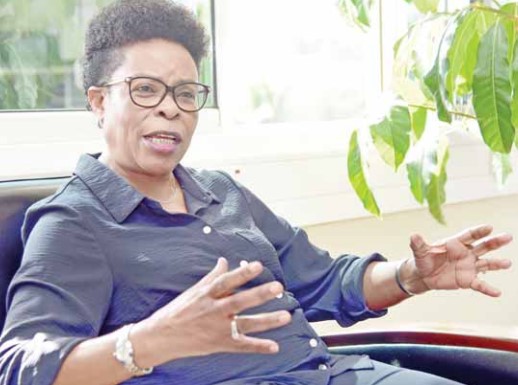
Ms Beti Kamya, the Inspector General of Government, observes that women are often challenged by people’s mindset on leadership, especially when their capability to lead is watered down. She speaks to Gloria Irankunda about her work and everything else about social justice.
Ms. Beti Kamya, the Inspector General of Government, says she did not pursue a career in public service. However, she was very vocal on the question of justice, human rights and corruption while growing up.
Ms. Kamya was born in Kenya at a time when the Mau Mau Rebellion was at its epitome. She was often intrigued by her parents’ and grandparents’ conversations about the rebellion.
“I have hazy memories of Mau Mau Rebellion talk that was in the late 50s and early 60s. Soon after independence in Uganda, we migrated to Uganda and there was still a lot of political talk,” Ms Kamya recalls.
During her school years, Ms Kamya’s curiosity gravitated towards current affairs, engaging in debates from primary school through university. She attended schools that had vibrant political debates like Kings’ College Buddo
“We had a very vibrant debating club and around that time, schools would have inter school debates which I participated in. Each school would represent a country and we would present the views, opinions and the culture of that country,” Ms Kamya recalls.
She recounts a time she was expelled from school during her ordinary level after she led a strike, something that brought out her leadership element.
“At Wanyange Girls School, 90 percent of the staff were white. There was a rude teacher and we thought she was anti-Africa. The girls started to say that she called them black monkeys. I am sure they were telling lies because no teacher would do that, but of course, I would not take it. . I said [should she really call us black monkeys?], so we decided not to attend class. A few friends and I made a riot at the school against the teacher and that is when my leadership and political activism came out,” Ms Kamya shares.
Even though not appointed or elected as a leader at school, Ms Kamya was established as a student leader. She says this is because during her day, prefects were appointed by teachers and she was never appointed as she was taken to be naughty.
“I always stood up against teachers. So, the teachers appointed somebody compliant,” says Kamya, adding that she has been a person with a following.
When Ms Kamya went to Makerere University, she graduated with a Bachelor of Commerce degree, majoring in marketing. While at Makerere, she boldly vied for the chairperson seat of Africa Hall and won. From that point forward, her trajectory was set in motion.
Getting to mainstream leadership
After 20 years of being in main politics both in Opposition and the government, Ms Kamya was appointed by President Museveni as Minister for Kampala Capital City Authority in 2016, Minister of Lands, Housing and Urban Development in 2019, and Inspector General of Government in 2021. According to her, this was because she stood out as a person who would fight for justice, good governance and human rights.
“I am an avid reader and writer. I used to publish articles in the papers and the President reads newspapers. Most of the time when I wrote something, especially criticizing the government, he would call me to discuss my point of view,” My Kamya asserts.
Ms Kamya’s notes that her journey in leadership has had its share of challenges from community expectations when she was a Member of Parliament, to having a mandate to do the role of investigating culprits of corruption, which is often not a bed of roses.
As a Member of Parliament, the community actually thinks you are their government. They come to you from school fees to coffins, land issues and food. Now that I have scaled down in my political activity, there are challenges in the office. You may be investigating someone and there are so many people calling you claiming that the person in question is their friend or relative, the person may be my friend too but I have a job to do and I accepted and took oath,” Ms Kamya explains.
She adds that while the struggle to fight corruption continues, people have made it generally acceptable in the country which has a ripple effect on everyone.
“The most difficult thing is our mindset as a people, especially towards transparency and corruption. Corruption is now a way of life and to break it requires a serious mindset change of the entire population where people understand that you can say no to corruption,” Ms Kamya explains.
She adds: “We are doing a lot of awareness among the population that corruption is hurting everybody, even those people in the comfort zones, it reaches them at times. One day you are driving and you think you are free from corruption but a person who bribed a policeman to drive a car in a dangerous mechanical condition will cause an accident on the road and kill you.
Mindset on leadership
Ms Kamya observes that women are often challenged by people’s mindset on leadership, especially when their capability to lead is watered down. For example, when she started the Uganda Federal Alliance (UFA) political party, she learnt that people felt that it would be much better if the political party was led by a man.
While women leaders face work challenges, personal challenges do not spare them too. Ms Kamya says it was not easy for her to raise six children after her husband passed on two decades ago.
“I had challenges of being a single parent and raising six children after I lost my husband. I would run from one school to another on visitation days. I thank God I went through it and they are all now grown and have given me grandchildren which is a very big consolation,” Ms Kamya shares.
Women empowerment
Ms Kamya says women at the grassroots level need empowerment and not those already in top leadership spaces who can fight their battles. She is inspired by women who beat the odds and venture into fields that are traditionally for men.
“I like women who break into the man’s world on their own, irrespective of their education, status and money. The woman who drives a boda boda or a taxi, those are the women who inspire me,” she says, adding that she is moved by women like Mother Theresa and Margaret Thatcher because of their character and achievements.
In her community, Ms Kamya started a community-based organisation called Lubaga North Development Association (LUNDA). Through the organisation, development programmes such as poultry and farming are passed on to women with low incomes as well as bursaries for school-going girls.
She affirms that the government programme of affirmative action is now entrenched in the law allowing for equal opportunities and gender balance.
Qualities of a leader
To Ms Kamya, the most important quality of leadership is integrity. Other qualities such as education build on that. This, she emphasizes, should be entrenched during childhood. She encourages parents to spend time with their children and promote the values of honesty.
“At whatever level of leadership, it should be the starting point. In schools where parents give children money for campaigns, it should be discouraged because children grow up with it. Some parents buy marks and exams for their children. How do you expect this child to be a person of integrity when they acquired their job through questionable means such as sex and money?” she wonders.
Ms Kamya recalls various moments of triumph, such as when she would be the first in class as a student as well as leading in different positions in the country: “I felt a real thrill when I was the Chief Executive Officer of Uganda Wildlife Education Centre since the buck ended with me, unlike other positions when I would report to someone.
Getting appointed as a minister and sitting in cabinet – those are very big moments. Finally, you are the Inspector General of Government responsible for controlling everybody in government to do their work according to the law.
Ms Kamya has maintained a work-life balance by adopting a healthy lifestyle. “I go to the gym, exercise, eat healthily, and do not drink alcohol. I try to sleep enough and spare time for things I love doing. I am a grandmother so I spend time with my grandchildren. When I come to work, I feel good about it because I have had a good time at home,” she says.
