


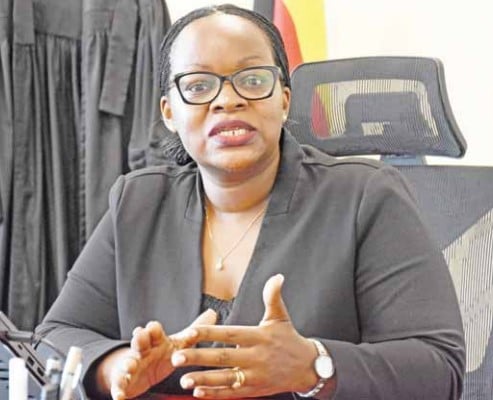
Good mentors, studying widely and having a support system are what have helped Mercy Kainobwisho become the leader she is, she tells Taaka Wandera Kuepwa.
Who is Mercy Kainobwisho? I am a female, Ugandan advocate of Courts of Judicature. I am a mother to a number of both biological and non-biological children, because I mentor; so many people.
And I am a wife. I am also a Rotarian, from the Rotary Club of Bukoto. I am a lawyer by profession, specifically in Intellectual Property and Business Law.
Currently, I serve as the Registrar General/ the accounting officer of Uganda Registration Services Bureau, a government agency in charge of business registration, civil registration, intellectual property and more.
When did you realise you were called to be a leader?
As far back as I can remember, there has never been a time in my life when I haven’t taken on a leadership role. Leadership seemed to find me starting from my days in Sunday school at All Saints Church in Mbarara.
I remember the Sunday school teacher always assigning me to lead and organise the other children, even though we were all just babies.
Even at home, despite not being the firstborn, my parents always singled me out for more responsibilities. I was quick, very energetic, the hands-on person in the family. I was the go-to person when it came to who to send to the shops or market, because I would go and come back quickly.
My leadership journey continued in school. In secondary school, I was appointed class monitor. I was then appointed minister of environment due to my cleanliness. Despite being in O-Level, I was made head girl, a position usually reserved for seniors in A-Level. I chaired the music dance and drama club and led the Interact club. I was also the chair of Scripture Union. Looking back, I marvel at how I managed to excel in my studies alongside all these responsibilities, and yet I did.
Take us through your leadership journey, how did you get to your current position?
I studied in western Uganda, for both my primary and secondary school. I loved sciences so I did physics, economics, math and fine art in my A-Level. I had envisioned a career in architecture, having been inspired by one of my uncles who was an architect. My mother, however, forced me to do law, citing the successful careers of my older sisters in the same field.
I enrolled in the Bachelor of Laws programme at Makerere University, and it was like a forced relationship for me. Towards the end of the second year, I realised I was studying for myself, and not my parents, and over time, I developed a genuine passion and love for the field of law.
I was in a relationship with my now-husband, who provided support and encouragement. I am profoundly grateful for the choice she made. I harbor no regrets, as it has been a pivotal factor in propelling me to the position I hold today.
On completing the degree, I got admitted to the Law Development Centre on government sponsorship. I then worked at Shonubi Musoke & Co Advocates as a legal assistant, gaining valuable experience in a conducive environment. It was amazing with people like Dr Allan Shonubi, and Mr Peters Musoke. It was during this time that I was introduced to Intellectual Property, which later became my specialisation.
I then joined the Ministry of Justice and Constitutional Affairs, was posted to the then Registrar General’s office, and I was in charge of intellectual property. While at the ministry, I pursued an MBA at Makerere University to enhance my leadership skills. I believed that enhancing my understanding of management would contribute to my ability to lead effectively. It was one of the best decisions I made.
Subsequently, I pursued a Master of Laws in Intellectual Property (LLM) at the University of Turin, Italy, and earned several postgraduate certificates in leadership, oil and gas, among others. In November 2011, I joined Uganda Registration Services Bureau (URSB) as the manager of the Directorate of Intellectual Property.
Over the years, I held various positions, and in December 2020, I was honoured to be appointed as the Registrar General of Uganda Registration Services Bureau.
Who influenced you and imparted the values that have brought you this far?
Whenever I’m asked about my mentors, I can’t help but mention my parents. My father, in particular, played a pivotal role in shaping my values from a young age.
He empowered us, ensuring equal rights for his daughters at home alongside the boys, he insisted that we had to go to school as well. Our father loved us and was actively present in our lives, going above and beyond typical roles.
Sometimes he cooked for us, he would take us shopping to buy us clothes, and yet my mother was present. Also, our home had a well-defined value system, every child had a responsibility, we had helpers, but their job was simply to supervise us.
My father had two wives, and I often encounter discomfort from some when I say that, because it is perceived as improper. I choose to share it because it exemplifies the effective governance I witnessed in our family. Both my mother and stepmother were not only friends but also had mutual respect for one another.
The absence of conflicts and quarrels between them showcased a harmonious coexistence, with clear boundaries being upheld. In instances where my father was invited to events, he attended with both wives, and it was a common occurrence for my mother and stepmother to discuss what outfits they should wear for such occasions. The success of this unique family dynamic was undoubtedly attributed to my father’s exceptional leadership and governance skills.
My parents were my first employers. In our business, I worked in the finance department and procured supplies for the business, so from early on I learnt work ethics and even integrity when it comes to money. The confidence, love, and care I have for others stem from intentional parenting.
perienced. I wrote a book on intentional parenting titled The Lessons from My Father.
What do you say has given you satisfaction throughout your journey as a leader?
Ensuring the wellbeing of our staff stands out as a source of immense satisfaction for me. That has been my greatest achievement. I have successfully communicated to our team that their welfare is a top priority. Empowering our staff , providing necessary resources, offering training opportunities, and prioritising mental health through health insurance has created an environment where they can thrive.
This achievement allows me, as a leader, to demand results confidently, knowing I’ve provided the support and resources necessary for success.
What are some of the challenges that you have faced?
Leadership is not easy, you are bound to face resistance every once in a while. People will judge you, and they will criticise. Some will say “taja kumalako, it will end in tears.” So if you are not firm and confident, you can easily resign. Others will try to bully you just to frustrate you. Then some people are simply not used to being corrected.
But you become better as a leader with time, as you learn. Every position requires different skills, if you are leading a department you will only think and plan around your department. But when you become a CEO and an accounting officer, you’re thinking beyond all departments.
As a leader, you are like a headmaster of a school, so you have to put up rules, you have to score marks, tell the people to pull up their socks, through appraisals. So if you come thinking people will simply do what is required because you have asked, you will be humbled.
Any mistakes you have made that stand out?
We are human, we all make mistakes, and for me, it was having very high expectations. You know when you are given an opportunity, you want to prove that you are capable, so you declare 100 days of transformation, but you can end up crashing. In that case, I put a lot of pressure on my team, not considering the diverse paces at which individuals work. I had to tone down, step back, and first empower people, while also leaving room for mistakes.
What advice would you offer to other women in leadership roles?
I would emphasise the significance of building a strong support system, and for me, that begins with family. It’s not just about the family you’re born into. It extends to the one you marry into, your spiritual family regardless of your faith, and of course, your work family – those colleagues you see day in and day out.
Having mentors is equally crucial. Identify individuals you admire, and those you look up to, and don’t hesitate to approach them for guidance. I cannot stress enough the power of reading. Dive into autobiographies of successful people, and explore self help books.
The Internet is not just for entertainment; it’s a vast educational resource. Seek out educational podcasts and content on platforms like YouTube. Continuous learning is a key to growth and success.
