


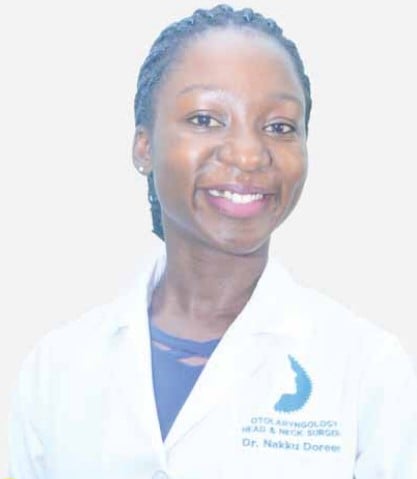
Dr Doreen Nakku is the Vice president of the Otolaryngology Society of Uganda (OSU), an umbrella body for all Ear Nose & Throat (ENT) specialists in Uganda. She is one of the few female ENT surgeons in the country. She interacted with Beatrice Nakibuuka about what it takes to succeed in her field of work.
Can you briefly share your journey in the ENT field?
My interest in ENT was triggered by necessity. I suffered from a blocked salivary gland duct that caused me discomfort while eating and it was recommended I get an evaluation from an ENT surgeon.
We were referred to a specialist clinic in Kampala (Kim’s Medical Centre) where I was evaluated by a foreign surgeon. We were referred to a specialist clinic in Kampala (Kim’s Medical Centre) where I was evaluated by a foreign surgeon.
At university, I enjoyed the rotation so much (led by Cuban expatriates only) that I recall walking into the Vice Chancellor’s office and inquiring about the possibility of an ENT post graduate course at Mbarara University of Science and Technology (MUST).
At university, I enjoyed the rotation so much (led by Cuban expatriates only) that I recall walking into the Vice Chancellor’s office and inquiring about the possibility of an ENT post graduate course at Mbarara University of Science and Technology (MUST).
This was one of the calls I have ever received and I do not regret the decision to do just that. At MUST,
I started as a single student but with massive administrative and social support. We now boast of a robust and thriving department with all local faculty and several post graduate students, both local and international.
Tell us a little about your education.
I attended St Theresa’s Girl’s Primary School, Namagunga and Mt St Mary’s College Namagunga. Later, I joined Mbarara University of Science and Technology for both my Bachelor’s and Master’s degrees. I completed a fellowship in Otology (Ear surgery) at University of British Columbia, Vancouver, Canada and recently, I finished an audiology diploma from the Eduplex Training Institute in Pretoria, South Africa.
How have you worked to impact and inspire other women?
Interestingly, one man’s meat is another’s poison. I do not believe you can go out of your way to intentionally inspire someone. Instead, your choices, judgment and actions are what might inspire them.
I try to be exemplary in my work, support other women surgeons through mentorship, friendship and hold them to the same standard as I do myself and male counterparts
In our programme, which is largely populated by women, we watch out and support each other, encourage rest and support each other during maternity break for both faculty and students alike
What challenges have you faced as a female leader in this field and how did you navigate them?
The initial tough challenge was learning to speak up for myself and in hindsight, it was more of imposter syndrome.
In a male-dominated field, it is not always easy being a junior female surgeon thrust into a leadership position, now sitting at the same table as those who taught you. There is pressure to impress and succeed.
What advice would you give to women leaders facing similar hurdle
Do not try to do it alone. Many others have successfully navigated these positions before you. So, seek them out and learn from their experiences I will share a moment that I am not necessarily proud of but one that gives me joy
Can you share a project or moment that you achieved as an ENT specialist and are particular?
I will share a moment that I am not necessarily proud of but one that gives me joy. I had a three-year-old patient who had delayed speech, behavioral changes and terrible breathing difficulties.
The child had been diagnosed with early childhood hearing loss and recommended for hearing aids.
However, all he needed was an adenotonsillectomy (an operation to remove both the adenoids and tonsils) and insertion of ear tubes to solve his problem. With speech rehabilitation and enrolment into daycare, he is now an active child with good hearing and voluminous speech.
These are the kind of moments that renew your strength as a doctor because we see so many that do not always turn out well
How do you intend to mentor and create more opportunities for women interested in pursuing a career in your field?
I and all my colleagues in ENT are always happy to have a chat on the endless opportunities in our field. I believe we can mentor future surgeons well if we reach them during medical school, support them during residency training and continue the mentorship even after.
Professional bodies such as OSU (Otolaryngology Society of Uganda) and WISA (Women in surgery association) are wonderful gateways into understanding the field and gaining mentors before even the decision to join a certain specialty is made.
It seems there are very few women in the ENT field. How do you maneuver? How are you ensuring gender diversity?
Definitely this table has either blanked out or even tipped in favor of women. Currently, we have more women ENT surgeons, with the department at MUST being fully female facilitated. We also have an equal balance of male and female residents. Makerere University also has a significant number of female surgeons and students. The current training climate is a lot more favorable for women doctors than it used to be, which is a great thing.
Are there mistakes you regret as a leader that looking back now you would do differently?
Not getting mentorship and training in leadership early enough. I found myself acting more as a boss than a leader so I burnt myself out severally from failure to delegate and manage time. I am grateful that now I have better insight into balancing leadership and management.
What are your aspirations for the future and for the broader representation of women in the ENT field?
I look forward to a time when as women surgeons we are given the same opportunities and support as our male counterparts. A time when we do not have to work so hard to prove ourselves qualified and capable. A time when women stand up and support fellow women.
My personal career aspirations are still in line with better advocacy for ear and hearing health in our country. This is largely under emphasized and yet we are all possible patients of ear disease and hearing loss.
I hope that you will join us in this cause, especially on March 3 every year as we commemorate World Hearing Day. We hope to continue spreading awareness across the country until better political support is accorded to hearing health
