


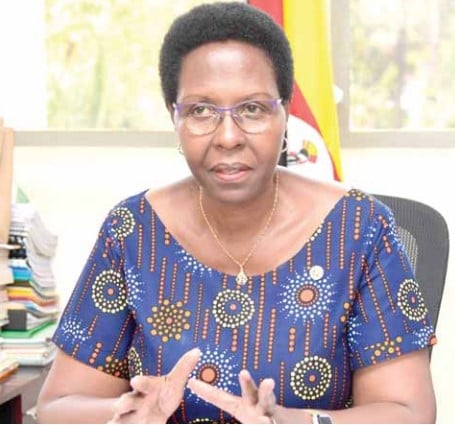
Dr Rosemary Byanyima Kusaba, the acting executive director of Mulago National Referral Hospital, first served in the medical field in different capacities before she became a leader. She speaks to Gloria Irankunda on what it takes to pursue a career in the medical field
BY GLORIA IRANKUNDA
I joined Makerere University in 1986 to study a Bachelor of Medicine and Bachelor of Surgery (MBChB) and become a doctor. After completing my studies, I did my internship at Nsambya Hospital in Kampala, after which I was appointed medical officer and posted to Mulago National Referral Hospital in the psychiatry department where I worked for two years.
With an appointment from Makerere University, I became a senior consultant radiologist in 2012 after developing my career as a radiologist, which I did for two years. I was then appointed to head the directorate of diagnostics, which includes radiology, clinical lab, pathology and nuclear medicine, which I did for close to eight years.
I then took a break but in the meantime, I was requested by the Ministry of Health to chair the National Advisory Committee on Medical Equipment. This was quite demanding, requiring me to often travel upcountry and out of the country ensuring we get quality equipment in the hospitals with consultation from different specialists.
In 2019, I was requested to be the acting deputy executive director of Mulago National Referral Hospital when the incumbent retired. When the post was advertised in 2020, I applied and was successful. In March 2022, I was requested to sit in as the executive director, a position I have held to date.
What challenges have you faced as a leader and how have you dealt with them?
As a girl child, joining university for a five-year course was a little bit of a challenge. Everyone would say you are going to leave university an old woman. But once you start studying, you do not look back.
The course is quite demanding. Even during the holidays, I would go to the nearby private clinic to work and keep up to date. Exams bring a lot of anxiety, but when you have done a lot of practice, it is not a problem.
While working at the radiology department of Mulago National Referral Hospital, the emergencies would come in and I would work on them seamlessly and progress very well. I passed the master’s degree very well and my examiner recommended me for an apprenticeship at Wythenshawe Hospital in the United Kingdom. My teachers were also very passionate and hardworking. So, you just had to follow their example.
When I got into leadership positions, I realised that I also needed to learn management. I first did project planning and management from the Management Training and Advisory Centre (MTAC), Nakawa. Later, I undertook another course in human resource management for health and later a master’s in business at the Galilee College in Israel.
So, how did you end up as a leader?
It was through a church mentorship programme which we used to have towards Easter season. That time, the theme was deprogramming and reprogramming’. Our facilitator asked us to erase our mindset and reset and see whether there is something new you can do and do it better. I gave leadership a chance and I do not regret my decision.
Reflecting on your education and career, what have been your most significant milestones?
When I completed Primary Seven, I did not go to my first choice school, Maryhill High School in Mbarara. I, instead, joined Immaculate Heart Girls School, Nyakibale. I knew my performance was comparable to those who got a few points better than I did, so I could make it from there. I performed well and made it to Trinity College Nabbingo, which felt very good. Making it to Makerere University to do medicine was something great.
What strategies have you employed to overcome gender barriers and navigate traditionally male dominated spaces?
It is about what you deliver and giving people due respect. You do not want them to think that because you are a woman, you have arrived, then you cause friction. Take it as a business; give them a chance to do what they are supposed to do as you also fulfill your duties that have worked for me.
When chairing board meetings that are dominated by men, make sure you do not coerce them because you are a woman. Rather, tell them what they are supposed to do.
What hurdles do women who want to join the medical field face and what advice would you give them on overcoming these challenges?
Women may be hampered by their menstrual cycles which can be painful sometimes. However, even when these cause a delay in your schedule, such as missing a class, know that you can catch up.
When you are pregnant, you are a little slower. When you have had a baby, you are not rushed to further studies and move around freely as the men. Sometimes, you do not want to compete with men. And God has plans for everybody.
How do you maintain a healthy-work life balance?
It is about creating systems so that you are able to delegate. Just remember that even when you delegate, it is still your responsibility to ensure that everything runs smoothly.
Yes, there will be disruptions but in most cases, ensure you finish all you have to do in the office. I avoid taking work home. I also take time to socialise. I am a Rotarian, so I go for fellowship and meet friends at the beach and other places where we can have fun. I also travel for Rotary conventions and district conferences. I always take advantage of my leave days to spend time with my family.
What achievements are you proud of?
I am proud of my qualifications, my first, second and third degrees. When I finished my master’s degree in business administration because I also had an advanced diploma in telemedicine, I did some consultancy with various organisations and I am so happy about that.
I am also happy to have served on many boards, notably the medical board, which assists people to go for treatment abroad. Then the national advisory committee on medical equipment, the atomic energy council where we implemented the Atomic Energy Council Act 2008.
I also made my department grow because I participated in teaching many postgraduate and undergraduate students. I am always proud when I meet them and they are proud of the fact that I was their teacher or mentor.
What advice would you give to women who would like to pursue a career in medicine or healthcare leadership?
You must have passion for the medical field. It is not about just treating the patients; they become a part of you and you must have empathy and passion to take care of them. Sometimes, they call you at odd hours but because you want to see them get better, you are not bothered.
Some of the diseases we treat are infectious so you must learn to take care of yourself. Lastly, you should not concentrate on just getting the money. When you do the right thing, people will appreciate you in ways you cannot comprehend.
