


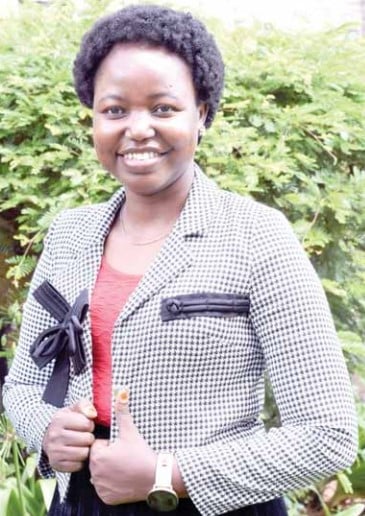
Ms Josephine Watera Semakula, a researcher, has worked at Parliament for 16 years now. The assistant director at the Department of Research in Parliament shares her leadership journey with Esther Tusiime Byoona.
Ms Josephine Watera Semakula, a researcher and assistant director at the Department of Research in Parliament, is a woman who juggles many roles.
Semakula is a born again Christian, a mother of five girls including a pair of twin girls, and is married to Mr Joseph Semakula. Her leadership roles range from that in Parliament to other organisations around the world in different capacities.
“I sit on the board for the Independent Evaluation Panel Global Fund based in Geneva. I also offer advisory services in monitoring and evaluation,” Ms Semakula says.
“I sit on the board for the Independent Evaluation Panel Global Fund based in Geneva. I also offer advisory services in monitoring and evaluation,” Ms Semakula says.
Ms Semakula is also in the advanced stages of completing her PhD at the University of Cape Town: “I am a doctoral candidate in Programme Evaluation,” she says.
Background
Ms Semakula’s education journey began at Kitale Union Primary School in Kitale Kenya. She proceeded to do her Ordinary Level at St. John Senior Secondary School Manafwa and her Advanced Level at Mbale Senior Secondary School.
Ms Semakula’s education journey began at Kitale Union Primary School in Kitale Kenya. She proceeded to do her Ordinary Level at St. John Senior Secondary School Manafwa and her Advanced Level at Mbale Senior Secondary School.
It was while she was pursuing her bachelor’s degree at Makerere University that she got an opportunity to collect research data by her lecturer Prof Augustus Nuwagaba, around the slopes of mountain Elgon.
He needed someone who was fluent in Swahili and Lugisu. “Professor Augustus reached out to a friend of mine and I was recommended for the activity,” she recalls.
When the data collection activity was accomplished, Ms Semakula knew she belonged in the research field. She kept in touch with Prof Nuwagaba who she says has guided her research path.
“I have done some research publications and I was inspired to pursue my PhD that is in research,” she says.
Non-negotiables
According to Ms Semakula hard work, dedication and interpersonal relationships have contributed to the success she has achieved.
She also believes that leaders should have certain non-negotiable traits to guide them in their work.
“I do not appreciate low quality of things and when people do not value the input of others. I feel like everyone has value in life,” she stresses.
Another non-negotiable trait she has is having and keeping values. She explains that she practices this and lift s the hands of women in her sphere of influence.
“I believe women have equivalent potential like men so any practice that segregates women and makes them feel they do not belong to a certain conversation, that is not right,” Ms Semakula stresses.
The value of mentorship
Growing up in a failed environment in Kenya pushed Ms Semakula to work hard for success.
“There was no role model for me to look up to in the whole neighborhood, it was normal for a girl to have children by the age of 14,” she recalls.
An encounter with a University student from Islamic University in Mbale in her advanced level however, inspired her greatly.
“The person was giving career guidance. He started talking about what we want to do in the future. Once I learnt what social work was about, I knew I wanted to be a social worker to cause community change,” Ms Semakula adds.
Meeting people like Prof Nuwagaba who was her first employer and is her mentor has kept her going.
“I applied and was called for interviews. He prepared me for the interviews and I passed. At the time I was working with him, but he was quick to release me,” she recalls appreciatively of how he has supported her.
She makes mention of a time when the Aga Khan Foundation advertised for a programme called Young Development Professionals. The professor saw the advertisement and told her to apply for it.
“I thank God for people that have pushed me well,” she says. The Young Development Professionals was an apprenticeship programme where Semakula spent one year, after which she joined Parliament where she has been to date.
Challenges
When asked about the challenges she has faced, she mentions perfectionism as one of them.
“I want to see things done in a given way,” she adds. Ms Semakula adds that she faces difficulty in being patient with people. “People can tend to be very sluggish and this is a big leadership challenge,” she says.
Delegating tasks to others is also challenging. “I can delegate assignments to people, but people give eye service. When I walk away, they do not deliver what is expected of them,” she notes.
Even then, Semakula understands that some of the times, like any other leader she makes mistakes, one of which is having trust issues with people once they do not deliver.
Even then, Semakula understands that some of the times, like any other leader she makes mistakes, one of which is having trust issues with people once they do not deliver.
“I end up losing out on my time and relationships since people do not put value on the time I have given them,” she adds.
Lessons
Along her leadership journey, the deputy director of research has learnt to communicate effectively and be simple.
“Sometimes people do not know what a leader is saying until it is communicated effectively, this will help in bringing clarity,” she observes.
She adds that simplicity is essential as a leader.
“The life we live is too complicated. There are a lot of things people go through. I want people to reach out to me when they need to,” she explains.
Advice to researchers
If anyone is interested in the field of research, Semakula advises that they should be willing to hear from others and accommodate their views. She also encourages researchers to read as much as possible in their preferred field of interest.
For those aspiring to be leaders in the field, she asks them to have a personality that is easy to follow. “You cannot be a leader without followers; it is important to build a personality that people can follow,” she notes.
Ms Semakula says a leader should be consistent with everything in life. “Consistency is very important, learning never ends. even failure is a lesson,” she concludes.
