


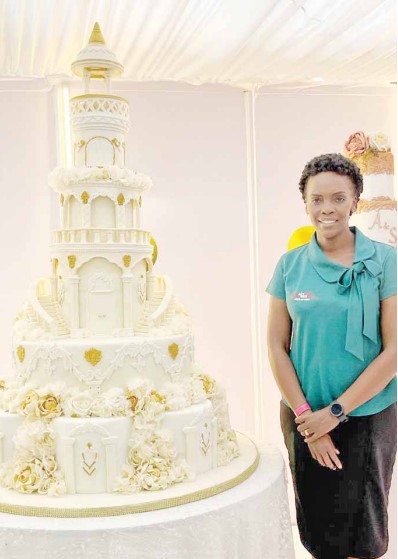
Mulema says she has empowered her staff and is not afraid to retire because she knows her business, Bake4Me will continue even without her, writes Promise Twinamukye
The story of Brenda Mulema’s Bake4Me company, is one of humble beginnings, something she did not see herself doing fulltime at first. It all started with her cousin ordering a cake from her and providing her with Shs10,000 to buy ingredients.
When she delivered the cake, her cousin’s other friends ordered too. She went home, borrowed Shs25,000 to buy more ingredients and made the two cakes, earning Shs20,000. Even with the loss of Shs5,000, she knew she would be doing this for some time.
Mulema, who had studied food science and technology at Makerere University, ended up being interested in bakery, and followed her mother’s passion in often creating a pastry or two for the family.
Juggling the baking business with her work was quite the challenge, however. She registered Bake4Me in 2004 and found herself busy with the business.
“I would work at the office during the day, and bake at night when I had orders. The orders kept increasing through referrals and me marketing myself,” she says
In 2008, she felt the urge to study more and left for Pretoria, South Africa and did a Master’s in Public Health. She then worked on some projects for the Bill and Melinda Gates organisation for two years, but after that decided she wanted to settle down. She came back to Uganda, and got a job at Mulago hospital, where she worked in the casualty unit.
By then, her bakery earned her Shs2 million to Shs3 million a month. It was at that point that she decided to leave the work she did not enjoy doing.
“I did not want to see anyone in pain. Working in casualty units did not help the situation. I chose to celebrate with people by making cake for them,” she says.
She kept hiring more employees and today, she has 80 staff and five outlets.
How she leads her team
As a leader of her business, Mulema says she empowers her staff, which she says has helped because now she is not afraid to retire as she believes the business will continue to run even when she is not there.
“I like to empower people to be the best they can be in the business. This gives me comfort when I have to step out for some time knowing the business is still in good hands. It also frees me and helps me find time for other things. Because of that, I am gradually growing out of my business, a sign of new things coming,” she hints at changes that might be around the corner.
Mulema, however, says empowering people sometimes comes with cons: “Some employees misuse power and soon they start to behave like they own shares in the business. This means that you have to keep tabs on them once in a while to make sure everything is running according to plan.
At the end of the day, however, she encourages women to work towards getting the businesses to run even without their presence.
“Learn to grow out of your business and create continuity. This comes in handy when you are not around, the business can stay on flourishing. Look at the likes of UBL [Uganda Batteries Ltd], JESA… The owners are long gone but the businesses are still blooming,” she points out examples.
Mulema states that women tend to be empathetic and cautious on how they should do this.
“We women tend to be more empathetic and at times think with our hearts. When someone comes with a problem, you want to go all out to help them. In the end, that can even collapse a business. Learning to put a structure in place helps in navigating some of the emotional issues,” she advises
The risk-taker
Mulema also shares that a leader has to learn to take risks to enable the business to grow, saying that she has taken some and she is glad they have paid off.
“My decision to start importing ingredients was one big risk I took. When it comes down to it, you realize you have to incur a lot of costs including shipping taxes among other things. However, in the long run, I do not have to compromise on the ingredients when I cannot find them on the Ugandan market. Plus, I got someone based in the Middle East and now I do not have to incur costs of tickets to and from there to pick and buy ingredients,” she says.
Mulema also talks about other tough decisions she had to take, including personal ones.
“I had to freeze what I was doing at some point, while in Pretoria, to come back to Uganda and have a family. However, this is a decision I do not regret. There will always be those tough decisions and you have to figure out how they will affect your life once you make them, so you can live without regrets,” she states.
She also encourages women to find a balance between work and home. There will be tough days, she admits, but one should work hard at the beginning to afford time later on.
“There will always be a time when you have to make a sacrifice. I cannot be sending cakes to about 15 people a day and get time to take the children out. There is all this struggle in the beginning, however, that lays ground and later, you find yourself with enough time to do all the things you were not doing before,” she says.
Mulema states that as a leader, she is intentional and teaches her female employees how to save so that they can stand on their own, even when they are no longer working with her.
“Doing something out of your work gives you security. If your salary is delayed, you easily have another outlet bringing in money to sustain you and the people you support,” she says.
She also advises women not to stop learning from those better than them. “It is through that that you get exposed to bigger and better things to help you grow in your career,” she emphasizes
Mulema believes in being humble as a leader because it will be rewarded. “Many good things come from unexpected places. One of the people’s hand I held is now the one helping me ship ingredients from the Middle East, saving me a lot of money and time.
Be humble and when your heart is in it, you are probably right,” she says, adding that women should also have integrity as they go about doing business. “Pay service providers and employees on time because this creates a good name. A good name is good for business,” she concludes.
