


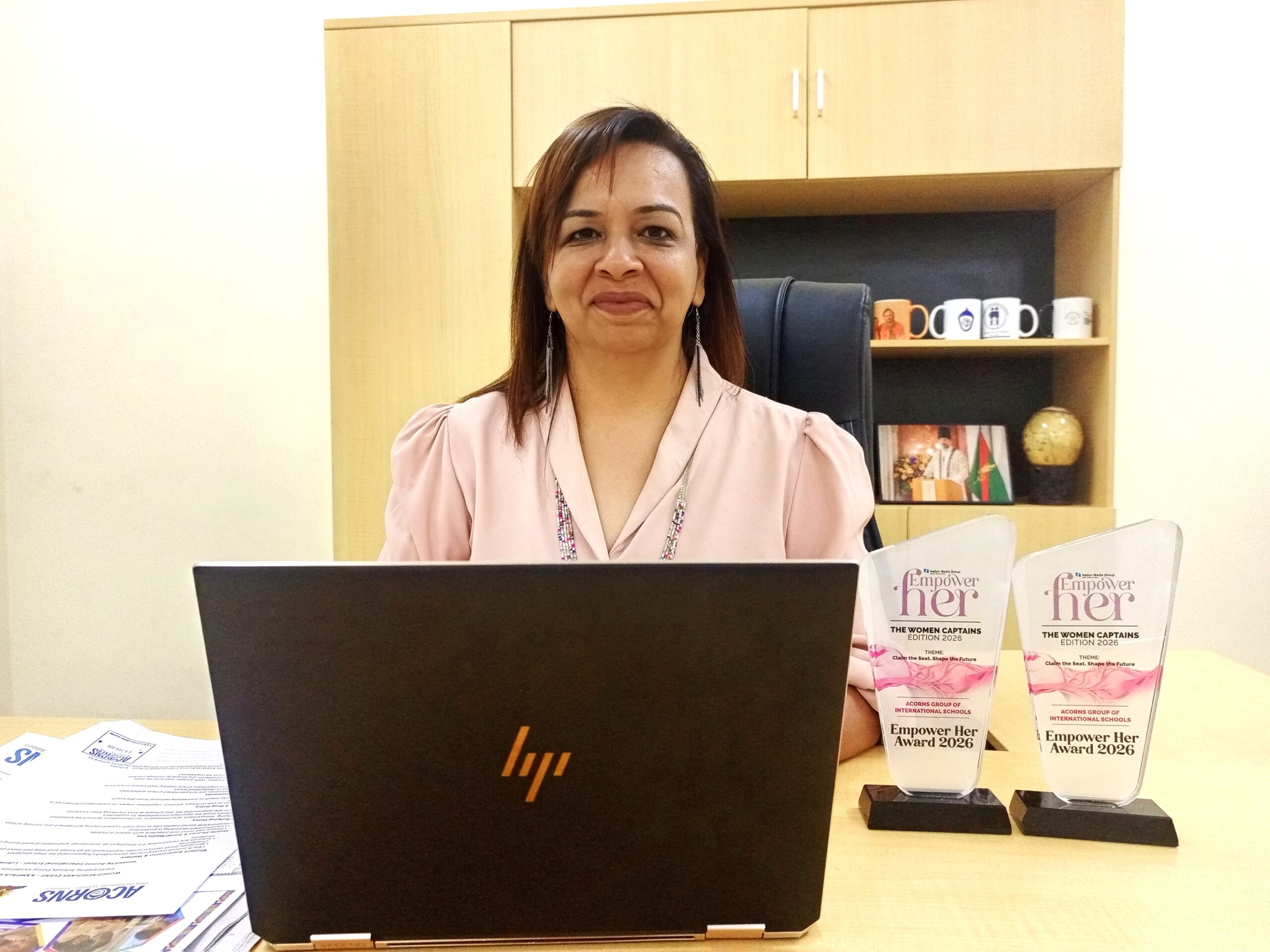
Ameena Lalani’s journey from a young teacher to CEO of Acorns International Schools reflects a steady, purpose-driven effort to reshape education in Uganda through inclusivity, innovation, and a focus on holistic child development.
When Ameena Lalani came to Uganda 14 years ago, there was little indication that her journey would one day reshape education for hundreds of families.
Her passion for teaching had begun years earlier. At just 20, while still a college student, Lalani found herself teaching within her community as a religious education teacher. That moment became the first step in a much larger story, fuelling her steady rise into leadership.
From there, she transitioned into Montessori education, a system that emphasises child-centred learning. This early exposure influenced her broader educational philosophy, one that prioritises inquiry, critical thinking, and the holistic development of each child.
“I moved to Uganda when Acorns Schools were still at the preschool level, and the directors were planning to launch a primary department,” she recalls.
Lalani was tasked with leading this initiative, starting with just four students in a small house in Bukoto, Kampala.
From four students to a thriving institution
The period of building the primary level was characterised by intensive research and careful decision-making. Lalani studied several curricula, including Cambridge and the International Baccalaureate (IB), before selecting a model that aligned with her vision for education in the Ugandan context.
“I zeroed in on the IB curriculum. And the directors were very much in line with my thought process and vision,” she shares.
Over the last decade, the school, which began with four children, has grown into a campus of more than 800 students. Lalani notes that this transformation was not driven by aggressive marketing or external investment, but something more organic.
“We hardly invested anything in marketing. It was purely word of mouth,” she says.
Parents became advocates, students became ambassadors, and the school’s reputation expanded through lived experience.
Adapting to a new model
One of the most significant challenges Lalani faced was ideological. The curriculum she championed differed from traditional education systems in Uganda.
“To sell the IB curriculum to the parents, students, and the community was the hardest thing,” she recalls.
In a system where education was often equated with exams, textbooks, and measurable outcomes, Lalani introduced a model centred on inquiry, critical thinking, and holistic development. Convincing stakeholders required more than explanation.
She found herself engaging not only with parents but also with government authorities, particularly during the licensing process.
“To explain to the ministry that this curriculum is not just about exams and results, but focuses on the holistic development of the child, was challenging,” she explains.
This shift in mindset was gradual. It involved demonstrating value through student outcomes: children who could speak confidently, think independently, and engage meaningfully with the world around them.
Building capacity from within
Another major obstacle was the shortage of educators experienced with the IB curriculum. Hiring from abroad was financially unfeasible, so the solution was to train local teachers.
“Within our infrastructure, we trained them, and they became the force,” she says.
By investing in professional development, Lalani created a team that not only understood the curriculum but believed in it. These educators became collaborators in the school’s mission, amplifying its impact.
Crossing borders
Nine years ago, Arcon International Schools expanded to Rwanda, a decision that emerged from a community need.
A group of parents, familiar with Acorn’s work in Uganda, approached Lalani with a proposal. A local international school was closing, and they wanted to preserve access to quality education.
Lalani and her team evaluated the opportunity and decided to step in. They retained a significant portion of the staff and rebuilt the institution under the Acorn model.
Nearly a decade later, the school is thriving.
As Acorn’s network has grown, Lalani has adopted a deliberate approach to expansion. Rather than replicating identical models across campuses, she has diversified curricula to meet different needs.
“Kisaasi offers IB curriculum while Lubowa and Bunga campuses follow the Cambridge curriculum. This dual approach allows the organisation to serve a broader population, including families with varying educational goals and international aspirations,” Lalani explains, adding that there are plans to set up additional campuses, each designed with specific community needs in mind.
Inclusive leadership
Today, Lalani leads four campuses: three in Uganda and one in Rwanda. As CEO, her focus goes beyond institutional growth to ensuring equitable access to quality education.
Lalani describes her leadership style as “inclusive and responsible,” a model that prioritises collaboration over hierarchy.
“It is not top-bottom. I consult and sit with others, and then we agree,” she says.
This approach extends across all levels of the organisation. School heads are actively involved in decision-making, and diverse perspectives are expected.
While this method requires more time and effort, Lalani views it as essential to building a cohesive and committed team.
“You have to hear everyone’s opinion and then you have to judge it,” she shares.
Lifelong learning
Despite her extensive experience, Lalani continues to position herself as a learner. She is currently a doctoral student in Education at Bethel University in the United States, with a dissertation on making international education more accessible and equitable within Uganda’s national framework.
This commitment to continuous learning shapes both her personal development and her institutional strategy on equitable access to education.
Gender and leadership
As a woman leading multiple institutions across countries, Lalani has encountered moments of self-doubt. She recalls instances where she felt intimidated in professional settings.
“The challenges never held me back, even when I was overlooked. Stepping into the CEO role and interviewing many male candidates pushed me to build my confidence, and once I did, I was able to lead with ease,” she explains.
She frames these experiences not as barriers but as moments of growth. Over time, she has developed the confidence to navigate complex leadership situations, including hiring and managing senior staff.
All four school heads are women, a result Lalani says is driven by merit-based advancement, with women making up 65 percent of leadership at Acorns International Schools.
“It is purely the competence; they have reached these stages based on their qualification,” she shares.
Arcon Group of International Schools won an award at this year’s Empower Her Women Captain’s Edition, an initiative by Nation Media Group aimed at spotlighting women leaders and celebrating inclusive organisations.
Lalani’s leadership has also been recognised at the national level, with Arcons International School being honoured as one of the Best International Schools at the 13th Visionaries of Uganda Awards, presented by the Vice President Jessica Alupo.
Success through impact
For Ameena Lalani, success is measured not by grades, but by the difference her students and teachers make beyond the classroom. She believes education should shape individuals who contribute meaningfully to their communities, guided by character, responsibility, and social awareness. This vision drives her commitment to inclusive education, where every child, regardless of background, has access to opportunity.
Through scholarships at the Kisaasi campus, subsidised fees, and targeted support for underserved groups, including refugees at Bunga and Lubowa, Lalani continues to expand access. “Success is when teachers and children go out and make a positive impact,” she says.

Comments are closed