


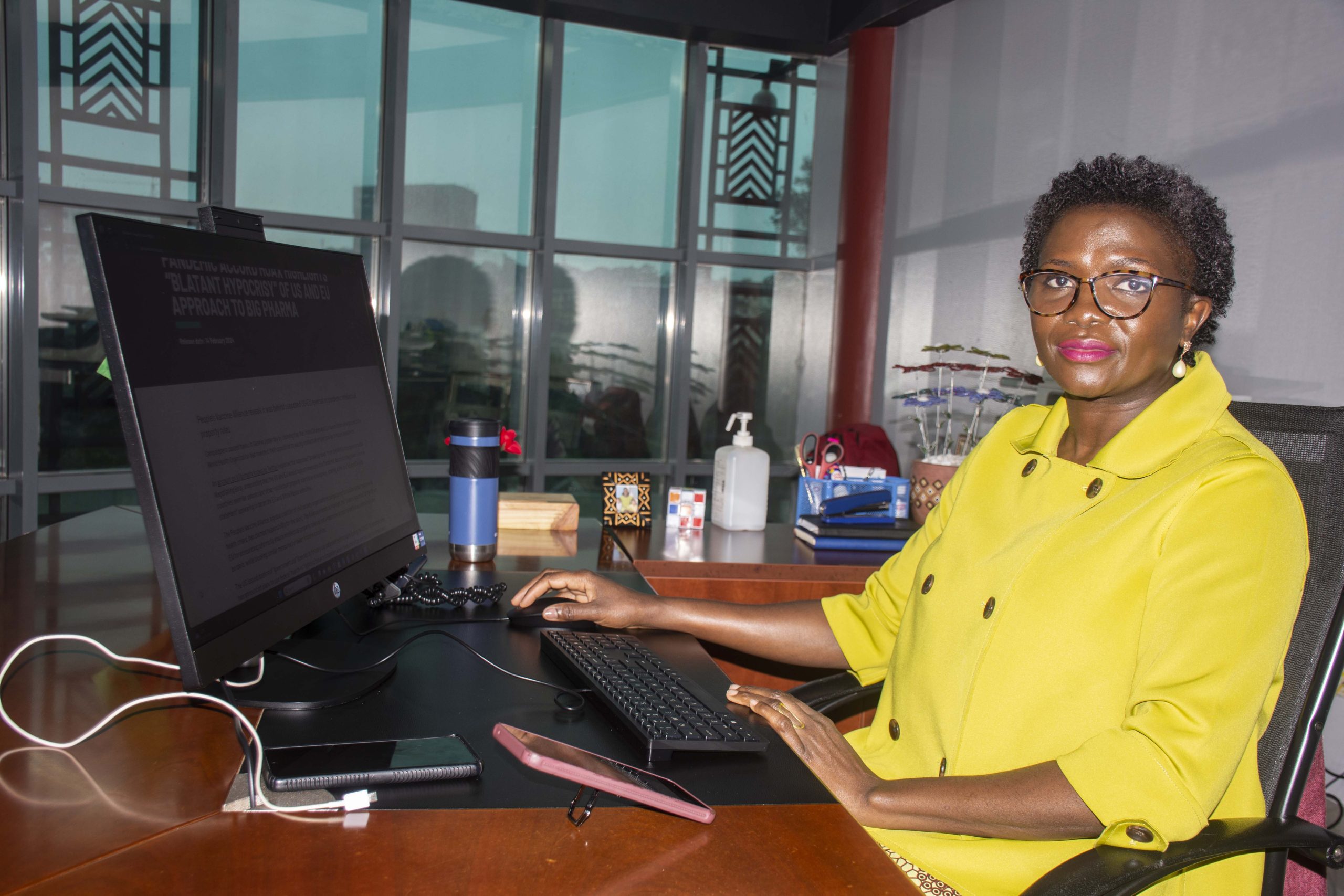
The Bureau Chief for the Aids Healthcare Foundation (AHF) for the Africa region says she is fortunate to be in a leadership position as it has allowed her to do more in terms of providing quality care to the patients, writes Joan Salmon.
When I see one of my twin sons climbing trees and being cheeky, I know where it comes from,” Dr Penninah Iutung laughs. She says this because she is the middle child of seven, and when young, would wander off in her world, without a care. That allowed her to be quite cheeky and naughty.
Despite that, she says her parents ensured they were all grounded and accountable, learning all home chores despite the gender.
“That made me resolve that even when I do not know something, I would rather try and fail, but never fail to try,” she says.
Dr Iutung is the Bureau Chief for the Aids Healthcare Foundation (AHF) for the Africa region, an international non-governmental organisation (NGO) working in 46 countries globally. However, when she was much younger, she had not envisioned herself working in medicine. She was always hands-on and thought the ideal university course was civil engineering.
“That was also partly because the scrapes and wounds from tree climbing and various experiments around the home led me to Mulago hospital, in the wound dressing room. The smell of wounds and penicillin made me detest having to work in those corridors,” she says.
However, with many engineers in the family, her mother needed a doctor and the lot fell on Dr Iutung and she took the course at Mbarara University of Science and Technology.
Embracing medicine
The marriage between Dr Iutung and medicine was not love at first sight. She detested it and was grumpy through her first year, sleeping for long even during exam time.
“I am thankful for my roommate who hailed from Swaziland and was doing her second degree in medicine. Seeing my frivolity, she urged me to appreciate what was handed to me and that conversation created a friendship that has spun decades,” she says.
The academic registrar, a friend of her father, also showed her the advantage of studying medicine.
“You don’t have to be a prescribing doctor,” he said, “You can do many other things, such as specializing in a field, doing research, or even.
That gave her a push to love and embrace medicine and she is thankful about the journey thus far. The next stop was medical placement and Virika Hospital was the destination.
“Virika was a very good place to practice medicine as the resources were available. Nonetheless, we had to learn to be frugal,” she says.
It was during the ward rounds that Dr Iutung saw the patients’ desperation, most of whom were HIV positive, continually battling with opportunistic ailments. The path to impact their lives was birthed.
With two opportunities to achieve her dream (one in Swaziland and another at AHF Uganda Cares), Dr Iutung took the latter.
“It was great seeing a patient that was brought in on a wheelbarrow or one who had a zero CD4 count walk again. I wanted to be a part of this miracle as it gave me purpose and satisfaction,” she says.
Joining AHF as a medical officer in 2004, the desire was to ensure that none left their four-roomed ward without medication. From 100 patients to 3,000, the number of patients on treatment increased, thanks to several donors and government efforts.
The journey to leadership In 2005, AHF got a care office and she soon became the national medical director, responsible for the clinical programmes for two years.
In 2008, Dr Iutung became the country programme director, then in 2010, she was appointed the bureau chief for the East and West Africa region. Two years later, she became the Africa bureau chief.
“Knowing that it is an honor to live a purposeful life keeps me grounded. Ultimately, my purpose is making a difference in people’s lives, a blessing not many people get. With my current obligation at continent level and responsibilities that stretch even to Europe, I know that whatever I do daily should improve people’s lives – the staff, the patients, or their families. Otherwise, there is a problem,” she says.
The doctor says she is fortunate to be in a leadership position as it has allowed her to do more in terms of providing quality care to the patients.
“In this space, I ensure that patient needs are met but also learn about engineering, my first love,” she says.
She is also thankful for the opportunity of a blank canvas that the job and organisation have offered her, where she is trusted to make several big decisions, with some guidance and accountability.
“For instance, in Masaka, I worked with the engineer to craft the building layout. Today, we have a commercial building and a clinic at the back. This has replicated across the 13 countries in Africa with AHF presence,” she says.
She has also worked to grow her teams by understanding the people’s individual strengths and struggles and how to help them.
Dr Iutung is thankful to the president of AHF, who is intentional about growing his leaders, with her being one of the youngest.
“He is my direct supervisor and rather than only focus on the agendas of our Monday meetings, he ensures that I am growing. That speaks to being dedicated to mentor me to become a better leader pointing and guiding me to work on the bigger picture,” she says.
Dr Iutung now inspires others, starting with those around her by hand holding them and dedicating time to help them grow. “I should not grow alone, so I grow those around me, especially the females,” she says.
Dr Iutung is also mentored by Ms Angelina Wapakhabulo who has been a part of AHF from the beginning, helping to set up the first clinics. “She is the first person I usually call, even on personal matters.
I urge everyone to find a mentor for accountability, moral support and growth because you will not always know everything,” she says, adding, “Leadership can sometimes be lonely as people will feel that you can or cannot be in certain spaces. In other cases, you need to make some unpopular decisions that may alienate you. A mentor makes this work feasible and doable.”
Nonetheless, Dr Iutung works to make fair and just decisions, aware that inclusion stems from the top. She ensures she is approachable, reachable and available as everyone, regardless of rank, deserves to be heard.
Challenges are part of the job and the doctor has had some tough ones come her way. The most recent was managing amidst Covid-19 because they needed to keep the clinics open.
“We led amidst the unknown and it was difficult, the lesson learned is that even when I feel fearful internally, I should never show it lest those looking up to me get discouraged,” she says.
The other was managing through the Ebola epidemic because the first Ebola patients in Sierra Leone were treated near their largest operation; one doctor was lost.
There have also been moments of great joy and achievement. One of her greatest wins is expanding the programme to 13 African countries from five and increasing the patient reach to a million.
The other is building a dependable team with structures that enable them to serve optimally.
Juggling life and work
With a job that touches lives globally, time zones are an issue. She has thus disciplined herself by setting priorities.
“For instance, unlike when we were setting up, when I had to make critical decisions, I now do not attend every meeting. That is also because we have grown the leadership team within the bureau,” she says.
She tries to strike a balance, ensuring she is available for her four-year-olds. That means leaving the office at 3:30pm if she has meetings at 5pm to spend an hour with them. It involves doing homework, reading and then negotiating with them to let her work for the next hour.
